By GoTaskhub Editorial Team · 13 min read · Updated October 2026
On this page
After a full day on site, the last thing most tradespeople want to do at 8:30pm is sit at the kitchen table with a notepad, a merchant website, and a spreadsheet trying to type up three customer quotes.
Yet delaying quotes is just as costly as rushing them. Take four days to send a price, and the homeowner has often booked someone else. Rush a single lump-sum figure over WhatsApp just to get it off your to-do list, and you risk forgetting fixings, waste disposal, travel time, or crucial exclusions that come straight out of your profit.
Learning how to quote jobs faster isn't about guessing numbers or cutting corners on your calculations. It's about removing the repetitive admin that slows you down—so you can prepare accurate, itemised quotes in minutes rather than hours.
The fastest way to reduce time spent quoting is to standardise the 80% of your pricing workflow that repeats on every job:
- Capture scope, measurements and photos before leaving site
- Pre-set your hourly, half-day, full-day and minimum charges
- Use saved templates and reusable packages for common jobs
- Qualify simple jobs via photos or initial estimates before driving out
- Use AI or benchmark estimators to assemble a fast first draft
- Send digital quotes that convert into jobs and invoices in 1 click
If you first need to work out your underlying hourly recovery rate, overhead allocation, and markup versus margin formulas, read our foundational guide on how to quote a job and price work profitably. Below, we focus specifically on faster quoting for tradespeople once your core rates are set.
Where Does Your Quoting Time Actually Go?
Before you can speed up quoting, it helps to look at why a seemingly simple quote ends up taking 45 to 60 minutes in the evening. Typically, the time isn't spent on the actual maths—it leaks away across five avoidable bottlenecks:
| Quoting Bottleneck | Why It Slows You Down | Faster Alternative |
|---|---|---|
| 1. Unnecessary site visits | Driving 30 minutes each way to look at a straightforward job where the customer hasn't even confirmed a rough budget. | Request photos upfront and send an initial estimate range before booking a visit. |
| 2. Incomplete site notes | Trying to remember pipe sizes, consumer unit spare ways, or gate access widths three days after visiting the property. | Use a 60-second site checklist and voice notes before leaving the driveway. |
| 3. Recalculating basic rates | Working out travel, small-job call-out charges, and standard material allowances from scratch every single time. | Keep a fixed rate card (minimum charge, half-day, full-day, standard packages). |
| 4. Typing & formatting documents | Copying an old Word doc or spreadsheet, fixing broken tables, re-typing terms and exclusions, and exporting a PDF. | Load reusable quote templates or generate an AI draft with pre-saved terms. |
| 5. Re-keying won work | Manually copying accepted quote line items into your diary and re-typing everything into an invoice weeks later. | Convert approved quotes into scheduled jobs and invoices in one click. |
When you eliminate those five bottlenecks, preparing a thorough, itemised quote drops from an evening chore to a 5- to 10-minute workflow.
9 Ways to Quote Jobs Faster
Here are nine practical ways to write quotes faster while keeping your pricing accurate and your profit margin protected.
1. Capture Job Details Before Leaving Site
One of the biggest time-wasters in quoting happens when you sit down at home and realise you didn't note down the ceiling height, the make of the existing unit, or how far the skip has to sit from the work area. You then have to message the customer, wait a day for a reply, or guess and risk underpricing.
Spend two minutes in the van before driving away to record a consistent set of details (typing them straight into a draft quote or dictating a quick voice note on your phone):
- Dimensions and quantities: Key measurements, linear metres, square metres, or fixture counts.
- Existing site conditions: Isolation points, earthing/bonding status, substrate condition, or ground levels.
- Access and logistics: Parking restrictions, narrow side gates, upper floors without lifts, or skip permit requirements.
- Who supplies what: Whether you are supplying all materials or fitting customer-supplied fixtures.
- Obvious exclusions: Anything you discussed verbally on site as not included (such as plaster patching, decorating, or carpet refitting).
2. Build Templates for Repeat Jobs
Even though every property is slightly different, roughly 70% to 80% of the jobs most tradespeople price follow a repeatable pattern. If you are typing out “Supply and install...” and your payment terms from scratch every time, you are doing unnecessary admin.
Create trade quote templates and saved line items for your five to ten most common jobs. Each template should pre-load:
- Standard itemised labour lines (e.g., strip-out, first fix, installation, testing/commissioning).
- Common materials, fixings, and consumables allowances so small costs aren't forgotten when you're rushing.
- Waste removal or skip hire lines.
- Your standard scope exclusions and validity window (e.g., valid for 14 or 30 days).
When a new enquiry comes in, you simply load the template, adjust the quantities or material specification for that specific property, and send.
3. Establish Your Minimum Charge
Small repairs and short call-outs often take longer to price than they should because tradespeople hesitate over what looks “fair” for a 45-minute task.
Instead of recalculating travel, preparation, van costs, and admin time for every minor job, establish a clear minimum attendance charge (covering travel within your standard service radius, setup, and up to the first hour on site) plus a fixed half-hour or hourly continuation rate.
Once your minimum charge is set, pricing a small job takes 30 seconds. If you haven't calculated yours yet, read our step-by-step guide on how to price small trade jobs and minimum charges.
4. Use Photos for Initial Assessments
Driving out to inspect every single enquiry in person is one of the fastest ways to lose 6 to 10 unpaid hours a week. Before booking a site visit, ask the customer to send two or three clear photos (or a short 20-second video) via WhatsApp or email, along with basic measurements.
- A wide shot showing the whole work area and access route.
- A close-up shot of the existing installation (e.g., pipework underneath the sink, existing consumer unit with the cover open, or fence post bases).
- Any model labels or measurements if replacing an existing appliance or fixture.
| Good Candidates for Photo Quoting | Jobs That Still Need a Site Survey |
|---|---|
| Like-for-like tap, radiator, or toilet swaps with visible isolation valves | Full bathroom refits, heating conversions, or concealed pipe leaks |
| Socket additions, light fixture swaps, or straightforward consumer unit upgrades | Full house rewires or properties with outdated/untested wiring |
| Replacing a known run of fence panels or clearing an overgrown garden | Multi-level landscaping, retaining walls, or complex drainage issues |
| Redecorating a standard room with clear wall dimensions and surface photos | Exterior masonry repairs requiring scaffolding or extensive timber rot repairs |
Even when a job eventually needs a site survey, reviewing photos first lets you spot deal-breakers immediately and give the customer an initial budget range before you spend fuel driving across town.
5. Keep Your Labour Rates Ready
You should never have to work out what your time is worth in the middle of writing a quote. Keep a simple, pre-calculated rate card ready so you can price labour in seconds:
- Minimum attendance / first-hour rate (for call-outs and minor jobs).
- Standard hourly continuation rate (including your overhead recovery share).
- Half-day rate (typically 3.5 to 4 hours on site, accounting for travel disruption between jobs).
- Full-day solo rate and two-person crew day rate (for larger installations and multi-day projects).
When you estimate a job by phase—for example, half a day for strip-out and prep, one full day for installation, and two hours for testing and handover—you simply multiply those blocks by your ready-made rates.
6. Use AI to Prepare Your First Draft
Blank-page syndrome slows quoting down, especially when pricing a larger or slightly unfamiliar job with a dozen different material, waste, and labour components.
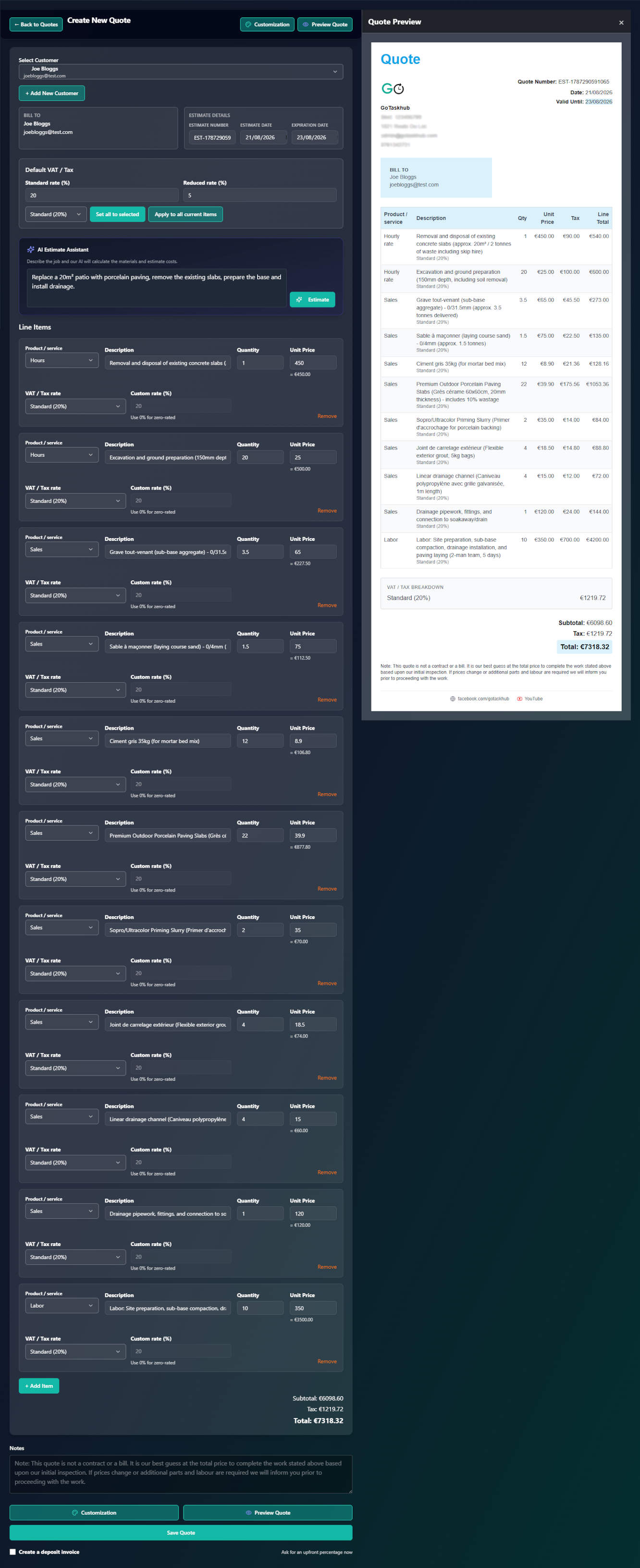
AI quoting for tradespeople works best when used as a fast first-draft assistant rather than an autopilot. Instead of typing every line item manually, you describe the job in plain English—for example: “Replace 20m² patio with porcelain slabs, excavate 150mm, lay MOT Type 1 sub-base, full mortar bed, and skip disposal.”
- What AI gets right: It quickly structures the quote into logical line items (excavation, aggregates, paving + cutting waste allowance, waste disposal, and labour hours) using UK trade pricing assumptions so you don't accidentally forget a stage.
- Where your judgement is essential: AI cannot see a rotten joist, a seized stopcock, or a 40-metre wheelbarrow run uphill, and local merchant prices vary. Always review and adjust quantities, unit prices, labour hours, and exclusions before sending the quote to your customer.
7. Separate Estimates From Fixed Quotes
Not every enquiry deserves a fully itemised, fixed-price quote on day one. Some prospects contact five tradespeople just to find out whether a project costs £800 or £4,000.
Protect your time by separating initial estimates from fixed quotes:
- Stage 1 — Quick Estimate (5 minutes): Based on the customer's description and photos, give a realistic price range and state your assumptions (e.g., “Based on the photos provided, a standard consumer unit replacement like this typically ranges between £550 and £700 + VAT, subject to an on-site check of existing earthing and circuit condition.”).
- Stage 2 — Fixed Itemised Quote: If the customer is happy with the ballpark range, carry out the site check (if needed) and send the formal fixed-price quote.
This simple two-step filter stops you spending hours writing detailed proposals for enquiries that never had a realistic budget.
8. Send Quotes Digitally
Formatting Word documents, fighting with spreadsheet margins, or writing out paper pads wastes time and creates friction for the customer. Most homeowners open quotes on their smartphone.
Using dedicated job quote software lets you build the quote once and send it immediately by email or shareable link:
- Your business logo, contact details, VAT settings, and standard terms are applied automatically.
- The customer views a clean, mobile-friendly proposal and can download a branded PDF anytime.
- With 1-click online approval, the customer can accept the quote on their phone in seconds, giving you an instant notification and a timestamped approval record instead of chasing replies by text.
9. Turn Accepted Quotes Into Jobs
Quoting speed isn't just about sending the proposal—it's also about what happens after the customer says yes. If you write quotes in one app or spreadsheet, keep your diary in another, and type invoices in a third, you end up entering the exact same customer address, scope description, and prices three times.
When your quoting system is connected to your job management and invoicing software, an accepted quote turns into a scheduled job and a deposit or final invoice in one click—saving another 15 to 20 minutes of admin per job.
Faster Quoting Workflows by Trade
Different trades lose time in different places when preparing quotes. Here is how to speed up quoting across common UK trades:
Plumbers & Heating Engineers
Request photos of existing pipework, stopcock location and flue/boiler labels upfront. Keep saved templates for tap swaps, radiator replacements, unvented cylinder services and bathroom first/second fix.
Electricians
Ask for a photo of the open consumer unit and meter cupboard before visiting. Pre-build templates with RCBO boards, SPD kits, testing hours and Part P notification fees ready to itemise.
Landscapers & Groundworkers
Standardise square-metre and linear-metre assembly templates for paving, fencing, turfing and decking—with MOT Type 1 tonnages, 10% cutting waste and skip sizes pre-linked.
Builders & General Contractors
Break quotes into clear phases (strip-out, structural/first fix, second fix, handover) and attach standard deposit and staged billing terms so you aren't rewriting payment schedules.
Painters & Decorators
Separate surface preparation (filling, sanding, masking, stain blocking) from primer and finish coats in reusable room templates so customers immediately see why your price reflects proper prep.
Property Maintenance & Handymen
Use a fixed minimum attendance charge for single tasks, or group multiple odd-job repairs into a half-day or full-day package with a standard fixings allowance.
Worked Example: Quoting a Plumbing Job Faster
To see how these steps work together in practice, let's walk through a realistic everyday scenario on how to quote plumbing jobs quickly without underpricing:
Replacing Two Basin Taps (Customer Supplies the Taps)
A homeowner messages you asking for a price to replace two bathroom basin mixer taps. They have already bought the new taps online and want a fixed quote for fitting them.
Step 1: Capture Requirements Remotely (2 Minutes)
Instead of driving out for an unpaid 45-minute site visit, you ask the customer for two photos on WhatsApp: one of the basin top and one of the pipework underneath. From the photos, you confirm:
- Standard 15mm copper feeds are visible underneath both basins, but only one basin has working service valves.
- Access under both basins is clear (pedestal basins, not concealed vanity units).
- The new customer-supplied taps include flexible tails, and you will supply two new 15mm compression isolating valves, PTFE/jointing compound, and washers.
Step 2: Identify Clear Exclusions Upfront
Whenever a customer supplies their own fixtures, a fast quote must still protect you if the parts are wrong or faulty. Using your saved plumbing template, your standard exclusions state:
- Customer-supplied materials: Warranty applies to installation workmanship only; defective, incompatible, or missing parts supplied by the customer may incur additional time if a return visit is required.
- Existing plumbing condition: Assumes working mains stopcock and sound existing pipework/wastes. Replacement of seized stopcocks, basin wastes, traps, or concealed pipework behind tiles is excluded unless agreed as a variation.
Step 3: Calculate Labour, Travel, Minimum Charges & Margin (Illustrative Figures)
Even though swapping two taps might take around 60 to 90 minutes on site, the job also involves 35 minutes of return travel, van stock replenishment, testing, and admin—roughly 2 hours of total business time.
Here is how the illustrative cost breakdown is constructed so you don't accidentally price it as a single hour of on-site labour:
| Cost Component (Illustrative) | Basis of Calculation | Illustrative Amount |
|---|---|---|
| Labour & Attendance (2 hrs total commitment) | Includes on-site installation, testing, local travel & overhead recovery @ £45/hr cost base | £90.00 |
| Sundry Fittings & Consumables | 2x 15mm compression isolating valves, olives, fibre washers, PTFE & sealant | £12.00 |
| Vehicle & Fuel Allowance | Local attendance fuel and parking allowance | £10.00 |
| Total Illustrative Job Cost | £112.00 | |
| Target Gross Margin (20%) | £112.00 ÷ (1 − 0.20) = £140.00 selling price | £28.00 |
| Illustrative Customer Quote (Excl. VAT) | £140.00 | |
Note: The figures above are illustrative examples for demonstration only. Always use your own hourly recovery rate, minimum attendance charge, supplier costs, and regional pricing.
Step 4: Prepare the Draft with the Estimator & Adjust
If you want a quick sense-check or a pre-structured itemised draft, you can enter “Replace 2 bathroom basin taps (customer supplied), fit 2x 15mm isolating valves and pressure test” into GoTaskhub's free plumbing job estimator or inside the GoTaskhub quote builder. You then review the draft line items, set the materials line to sundries/valves only (since the customer is supplying the taps), and confirm your £140.00 price.
Step 5: Send the Professional Quote & Convert to Invoice in GoTaskhub
Instead of texting “£140 mate” and hoping for the best, you send a branded, itemised quote in under three minutes using GoTaskhub:
Itemise Scope & Exclusions
Load your template or AI draft in GoTaskhub, review the live branded PDF preview alongside your line items, and send straight to the customer.
1-Click Digital Acceptance
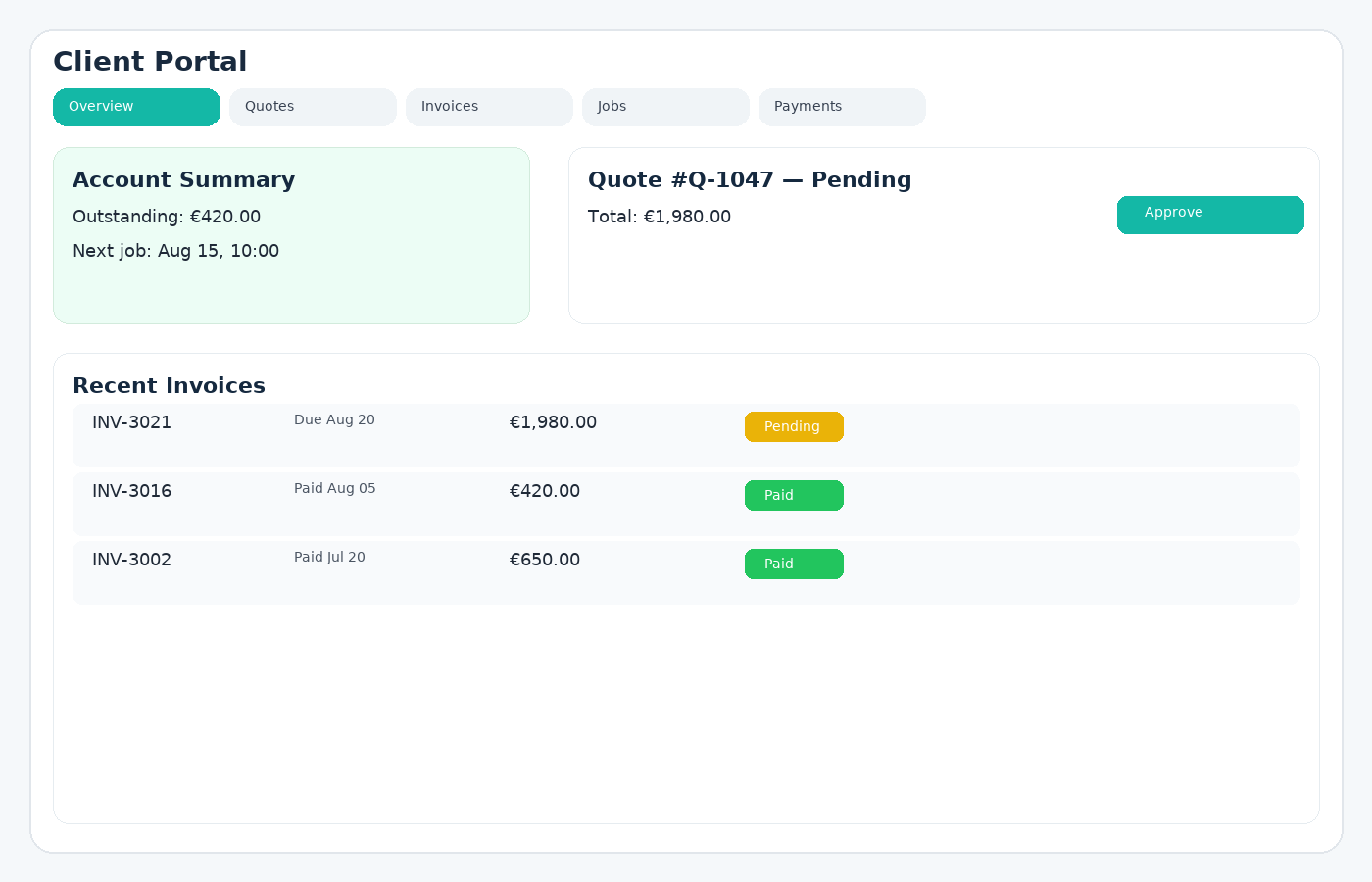
The homeowner opens the link on their phone, sees the clear breakdown and customer-supplied tap terms, and clicks to approve online.
Zero Double-Entry Admin
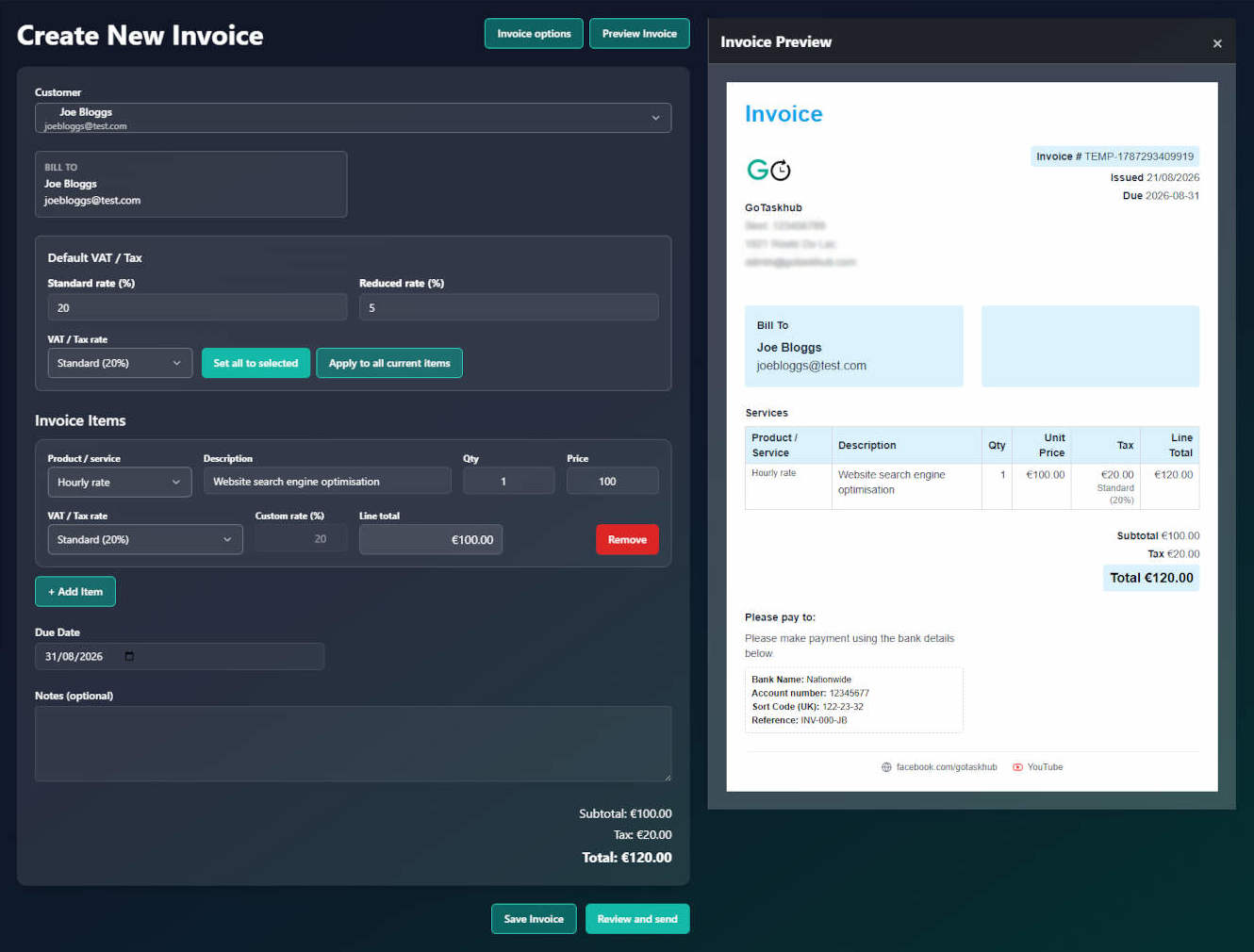
Once accepted, convert the quote into a scheduled job and generate the final invoice in one click with all agreed line items carried over.
Free Tools That Can Speed Up Your Quoting
You don't need an expensive enterprise system to stop spending your evenings on paperwork. You can speed up your quoting workflow today using two free resources from GoTaskhub:
GoTaskhub Free Job Estimator
Describe a job in plain English and get an instant, itemised UK benchmark breakdown for labour, materials, waste and overheads. Ideal for sense-checking a price or preparing a quick initial estimate—with no login required.
GoTaskhub Job Quote Software (Free Plan)
Build branded itemised quotes, save reusable templates, use optional AI-assisted estimating, get online customer approval, and convert accepted quotes straight into jobs and invoices. Free plan includes up to 3 quotes, 3 invoices, and 2 AI estimates per month.
Common Mistakes When Trying to Quote Faster
Speed only helps your business if the quotes you win actually make money. Watch out for these five common traps when speeding up your quoting process:
1. Sending a single lump-sum figure over text or WhatsApp
Texting a bare number like “About £650 for that” feels fast in the moment, but it strips away all context. The customer can't see the quality of materials, the preparation work included, or what isn't covered—and if another tradesperson sends a clear, branded breakdown for £720, the structured quote often wins.
2. Committing to a fixed quote from blurry photos when an estimate is safer
Photos are brilliant for routine jobs and initial ballpark estimates, but they don't show rotten sub-frames, non-compliant earthing, or buried concrete. When hidden conditions are possible, either send a non-binding estimate first or state clear conditional assumptions on your quote.
3. Forgetting waste disposal, consumables, and merchant runs
When tradespeople rush a quote in their head, they remember the main fixture and the on-site hours—but forget the £35 of fixings and sealant, the 45-minute merchant collection, or the waste disposal cost. Using a saved template with dedicated lines for consumables and waste prevents these silent leaks.
4. Leaving out exclusions and quote validity dates
A fast quote without exclusions invites scope creep (“I thought you were plastering and painting the wall afterwards too”). Always keep a standard exclusions block and a 14- or 30-day validity window built into your default quote template.
5. Never following up after sending the quote
Sending a quote quickly gives you a head start, but homeowners still get distracted. A polite, non-pushy check-in 48 hours after sending your quote significantly improves conversion without requiring any extra pricing work. Read our guide on how to follow up on quotes professionally without feeling pushy.
Continue Building Your Quoting & Pricing System
Connect faster quoting with accurate pricing calculations and higher conversion rates across these guides and tools: